
By Cliff Guthrie
Mullet fishing was a huge part of my childhood—and it’s one of the main reasons I developed such a deep love and respect for coastal life. It didn’t just teach me the value of hard work; it taught me quieter, more enduring lessons that have stayed with me ever since. I’ll share a few of those reflections at the end.

I often think back on how my family got involved in this summer tradition—and how the years have flown by. Only now do I realize just how poor we were back then, though we didn’t know it. To my family who took part in this tradition throughout my childhood, thank you for your love and kindness. Some of my best memories live along Shackleford Banks, Back Sound, Cape Lookout, The Straits, and Core Sound.
Most of all, I’m forever grateful to my parents. They made it all happen. They let me be a boy—curious, wild, and eager to explore—even when danger loomed.
A Family Tradition
Across the small coastal communities of North Carolina, mullet fishing—what we called “mulleting”—is a long-standing tradition. In my grandfather Chauncey’s eyes, it was a family affair. Every summer weekend, he brought along his children and grandchildren for this labor-intensive work.
Chauncey was a gill net maker by trade, and a mullet fisherman by tradition. Generations before him had relied on mullet as both food and income. My great-grandfather, John Henry, belonged to one of the last generations to make gill nets from cotton twine. These handmade nets, strung up to dry and mend along the shores of Harkers Island, were known as “the net spreads.”


During the off-season, they were made by hand using simple tools—a net needle, cotton twine, and a fid (a tool used to space the mesh correctly). My great-grandfather fished from a juniper-planked skiff named Old Hicks, built for catching hickory shad in Core Sound. That same tradition of fishing—and boatbuilding—was passed down to his children.
The Boats and the Nets
During my childhood, my grandfather and father built their own Harkers Island-style juniper skiff. It had a small, 25-horsepower inboard air-cooled engine. Alongside this powered skiff, they also used a “pole skiff”—a smaller boat built for hauling and setting gill nets, shaped specifically to be poled through shallow waters.


These pole skiffs had flat bottoms and a distinctive upward chine line near the stern, which helped them tow smoothly and avoid shearing in a wake. We called that feature the “tuck.” The oar used for poling was just as important: a long wooden pole with a small, tapered blade carved near one end. With it, a skilled operator—like my father—could steer from one side of the skiff with ease. A skill, I admit, I’m still trying to master.
A Day on the Water
We’d set out early from the shores of Harkers Island, usually from near my Uncle Will’s boathouse. The typical fishing crew included my grandfather Chauncey, my father Heber, my mother Diane, my sister Meredith, my uncle Will, and sometimes my grandmother Dorothy. On other days, we’d be joined by my great-uncles Julian or Vernon (when visiting from Arizona), or by my aunts Nancy Dee and Zina and their families. My cousins Beck and Susie were heavily involved before my father’s side joined in.


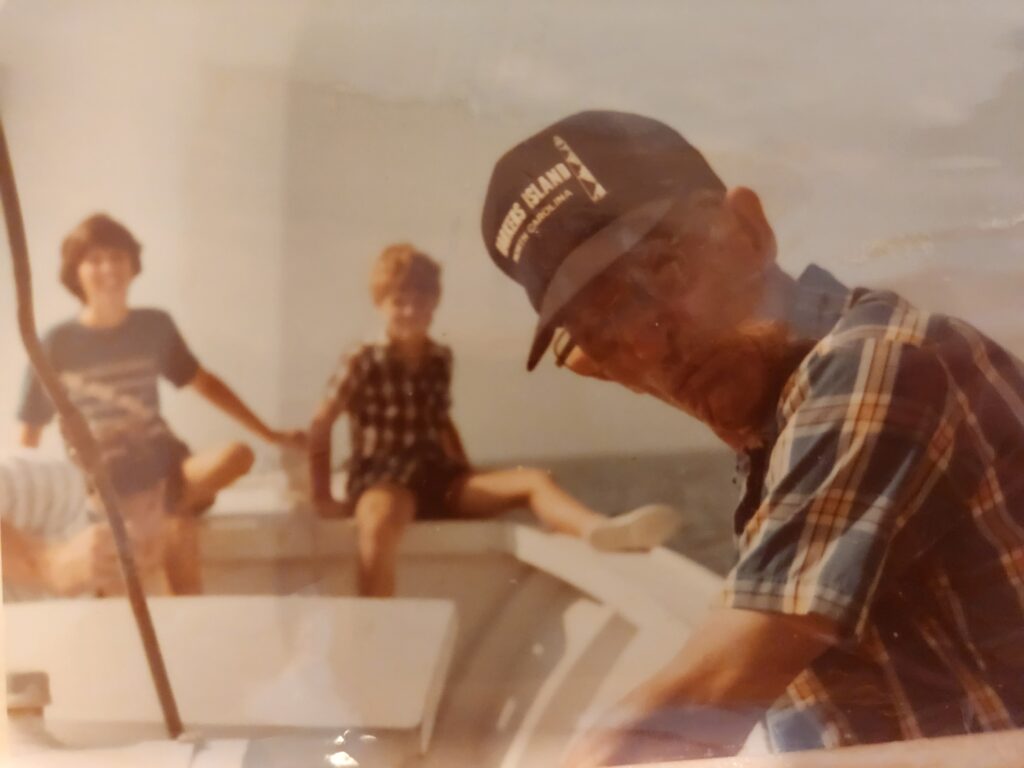
Granddaddy always had a crew—and he always put us to work.
He had special places he liked to fish: Bottle Run, Bald Head Bay, Whale Creek, Bells Island, and “The Banks”—our nickname for Shackleford Banks in general. He believed in rotating these spots every two weeks, allowing the fish to repopulate and giving the tides a chance to cycle. Smart fishing, even by today’s standards.

Spotting mullets meant watching for them to jump—the telltale behavior of the “jumping mullet.” Granddaddy wouldn’t set the net unless he saw several jumping in succession.

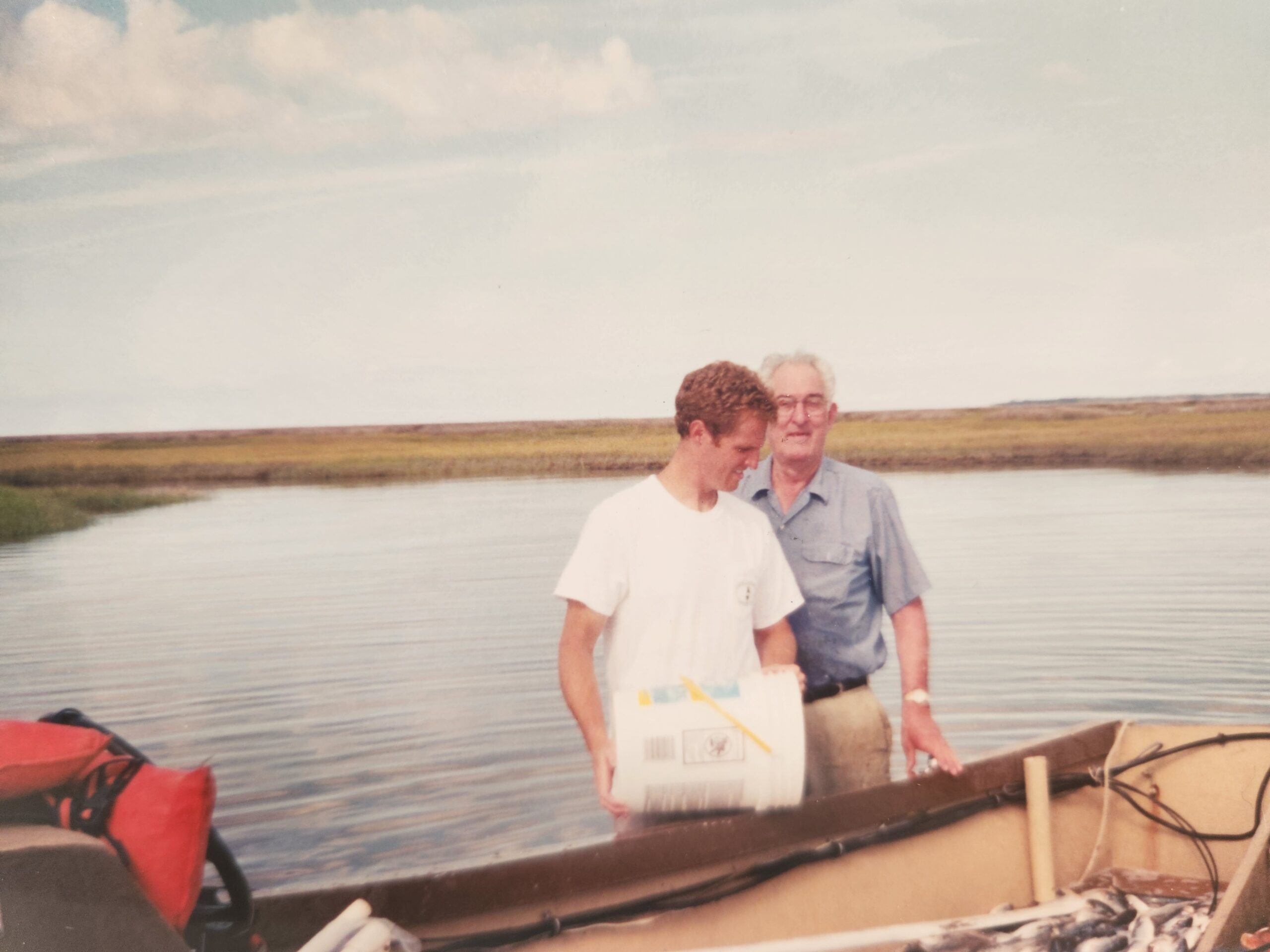
When it was time, my Uncle Will usually jumped out of the pole skiff first, pulling the worp—a heavy wooden staff with a weighted line attached. It took real strength to pull the net, dragging hundreds of lead weights across the soft bottom. This was Uncle Will’s job for many years, and later, it became my father’s.
The net would be circled around the school quietly and quickly, my grandfather and father poling the skiff while Will extended the loop. Once the net was in place, the whole crew would start tightening the circle. The mullets, realizing they were trapped, would dart back and forth, sometimes leaping the net in a final escape. As a kid, I’d squawk every time one got away, but Granddaddy would just say, “You can’t catch ‘em all, son.”

Only later did I understand the wisdom in those words.
My Job: Stirring the Water
Once the loop was mostly closed, it was my turn. I’d jump into the middle of the net and “raise Cain”—splashing, hollering, and running around to stir up the fish and prompt them to run. It increased our chances of catching the smarter ones, though it wasn’t without risk.
Often, stingrays would be caught in the net too. I had to identify them in the now-murky water, avoid stepping on them, and guide them out safely by lifting the lead line over their backs. Once the stingrays were cleared, the net would be tightened further.


Sometimes, a few large mullets were left in the final scoop—too big to “marsh” (our term for a mullet that was just the right size to be snared in the mesh). We’d pull the cork and lead lines together, forming a 4-5 foot enclosure. Then, we’d lift the whole thing up in a team effort, transferring the heavy, flopping catch into the skiff. Laughter always followed. It was the highlight of the day.
Coming Home
Granddaddy always rode home in the pole skiff. As a kid, I didn’t get it—why was he riding in the small boat while we celebrated in the bigger one? But now I know: he was inspecting and mending the net as we traveled, preparing it for the next haul.

Back on Harkers Island, the scene was beautiful. Elderly men and women from the community would gather at the shore with metal pans. Granddaddy would invite them to take what they needed—often giving away most of the catch and keeping just enough for our family.


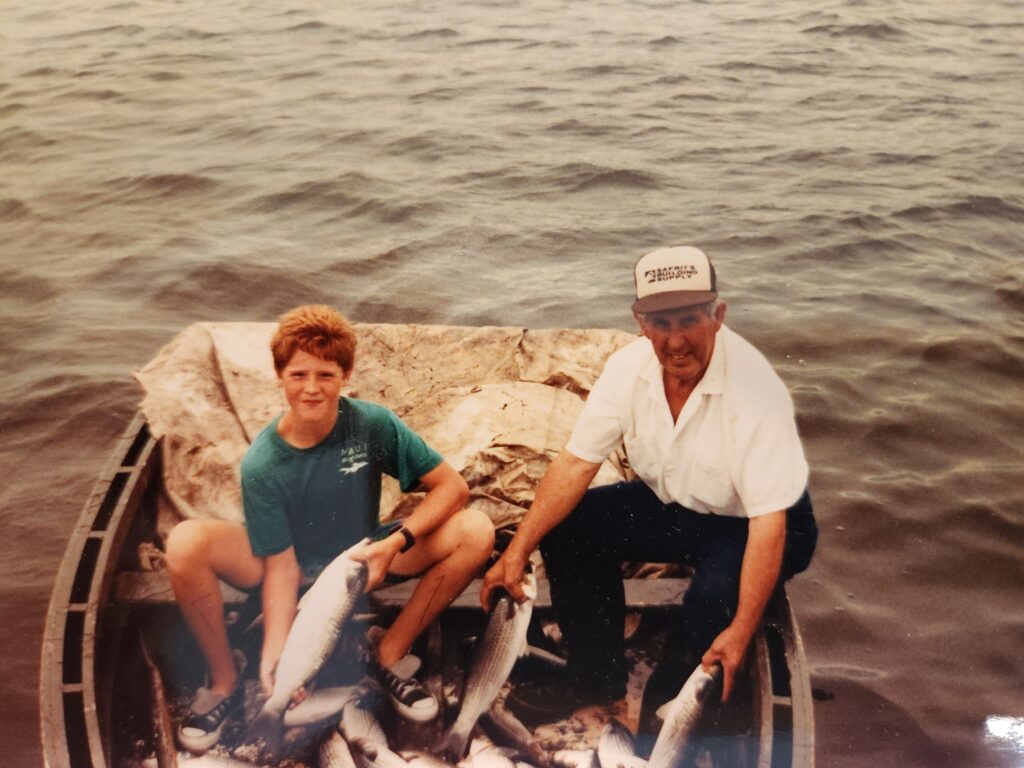
He never asked for anything in return.
Lessons from Mulleting
This family tradition taught me lessons that still guide me—and maybe they’ll mean something to you too:
- Life isn’t about being in the lead. Sometimes, the most important role is to make the path for future generations. Ride in the pole skiff.
- When it’s time, pass down the worp. Take the responsibility with pride and humility. And give it everything you’ve got.
- Share what you have. Whether they need it or not—just give. No judgment.
- You’re bigger than life’s stingrays. Be mindful of their stingers, and know when murky water is clouding your view. When you find one, just let it go.
- Some mullets escape. When life presents you with an escaped mullet, your attitude reveals everything about your perception.
- Celebrate with others. A shared catch is better than one claimed alone.
- Hold your family close. Hold your family close like a worp, you are the link to encircling them so jump in first. Someday they’ll be gone, and memories will only be left.
And the best memories?
They’re usually the mullets that don’t marsh.
So scoop them up—and hold them tight.




Leave a Reply